Safe school streets Charlottesville
2026-09-13 → 2026-10-04
Every child should be able to walk or bike to school, and every parent should be able to trust that they’ll get there safely. Walking and biking should be healthy, enjoyable options for families, with safe streets and crossings along the whole route.
Start here: some ideas for what we can do#
- Join the parent network and share ideas and concerns.
- Download the flyer to print or share with other families.
- Request a traffic-calming review through MyCville: flag a dangerous street or crossing and ask the City to assess improvements. You can also document a near miss with the Close Call Report.
- Organize a school-route walk with your principal and the City’s Safe Routes to School coordinator. Start with one difficult crossing or stretch of street.
- Take part in BPAC or join its email discussion group to help improve walking and biking in Charlottesville.
- Connect with Livable Cville, a local community advocating for safer streets and better ways to walk, bike, and get around.
- Start a bike bus or find another family to walk to school with.
- Subscribe to YY’s Bike Shed for my writing about streets and transportation.
Want to help organize, or need help joining? Reach out to YY Ahn. Safer streets benefit everyone, by making driving safer, the long school queue, by making the air cleaner, and by … Everyone is welcome, however your family gets to school.
Read more:
- Safer streets: Traffic calming · Traffic calming works · Traffic calming is cheap
- Costs, space, and traffic: Cost of car ownership · Cars are the least space efficient · Traffic evaporation
- Local action: My letter asking Charlottesville to make traffic calming the default · Charlottesville’s sidewalk priorities
Why#
Happier, healthier trips#
Walking or riding with friends can make the trip to school something kids look forward to. Walking and biking add daily activity, supporting fitness, attention and memory. CDC: physical activity benefits for children
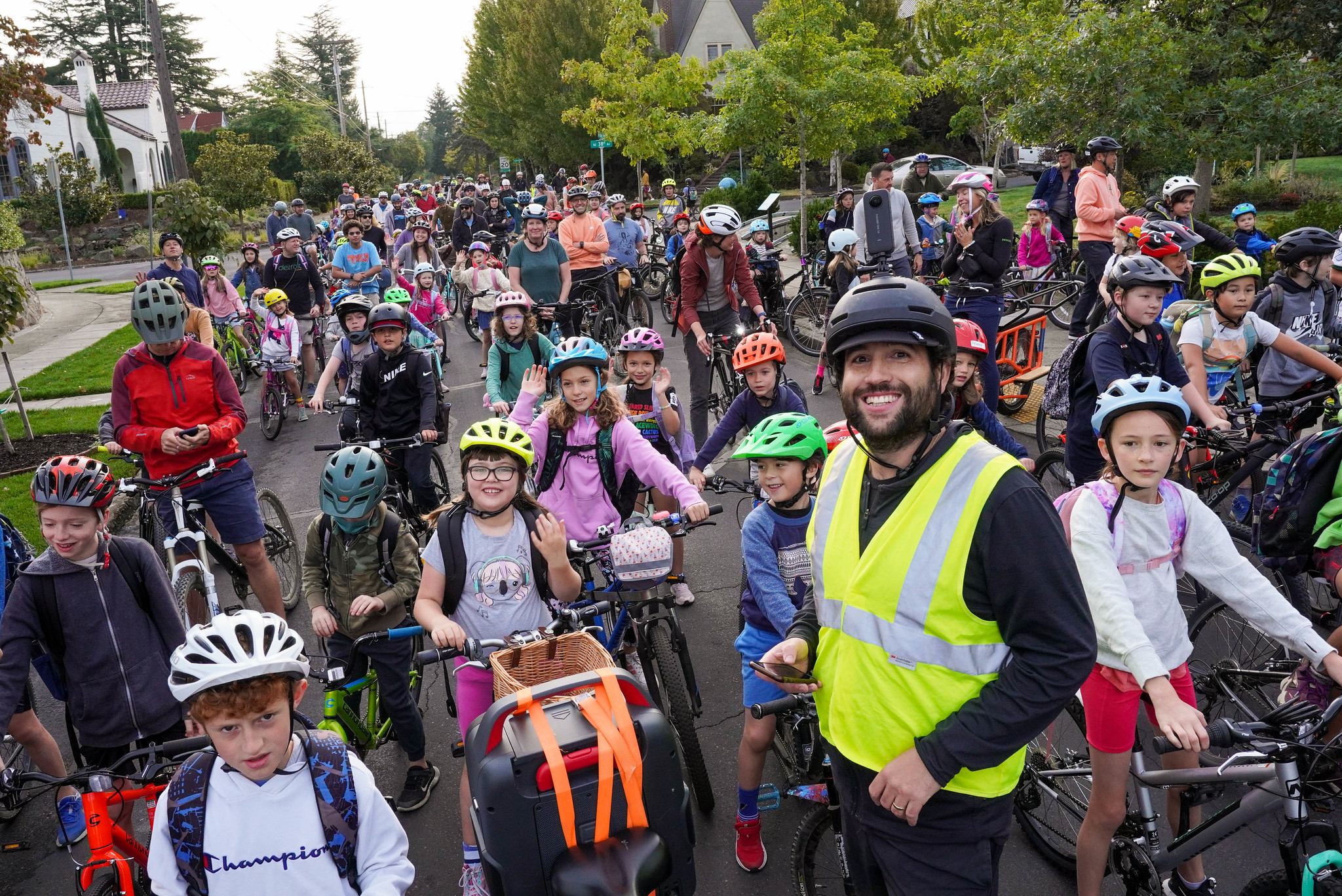
For more children to enjoy trips like this, we need safer streets.
Good street design protects everyone, especially children#
Traffic calming changes the street so drivers slow down and people have safer places to cross. Here are three examples.
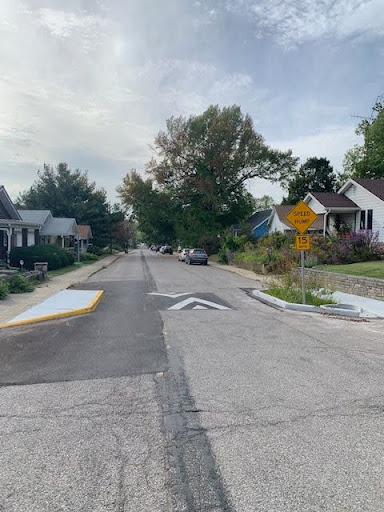
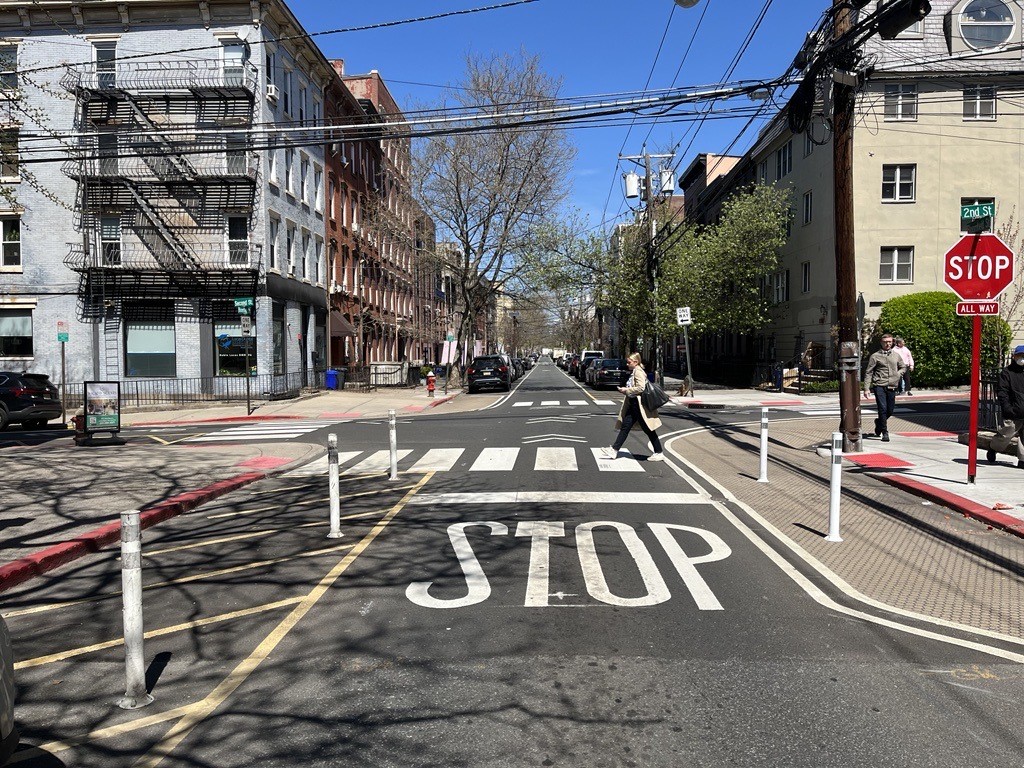
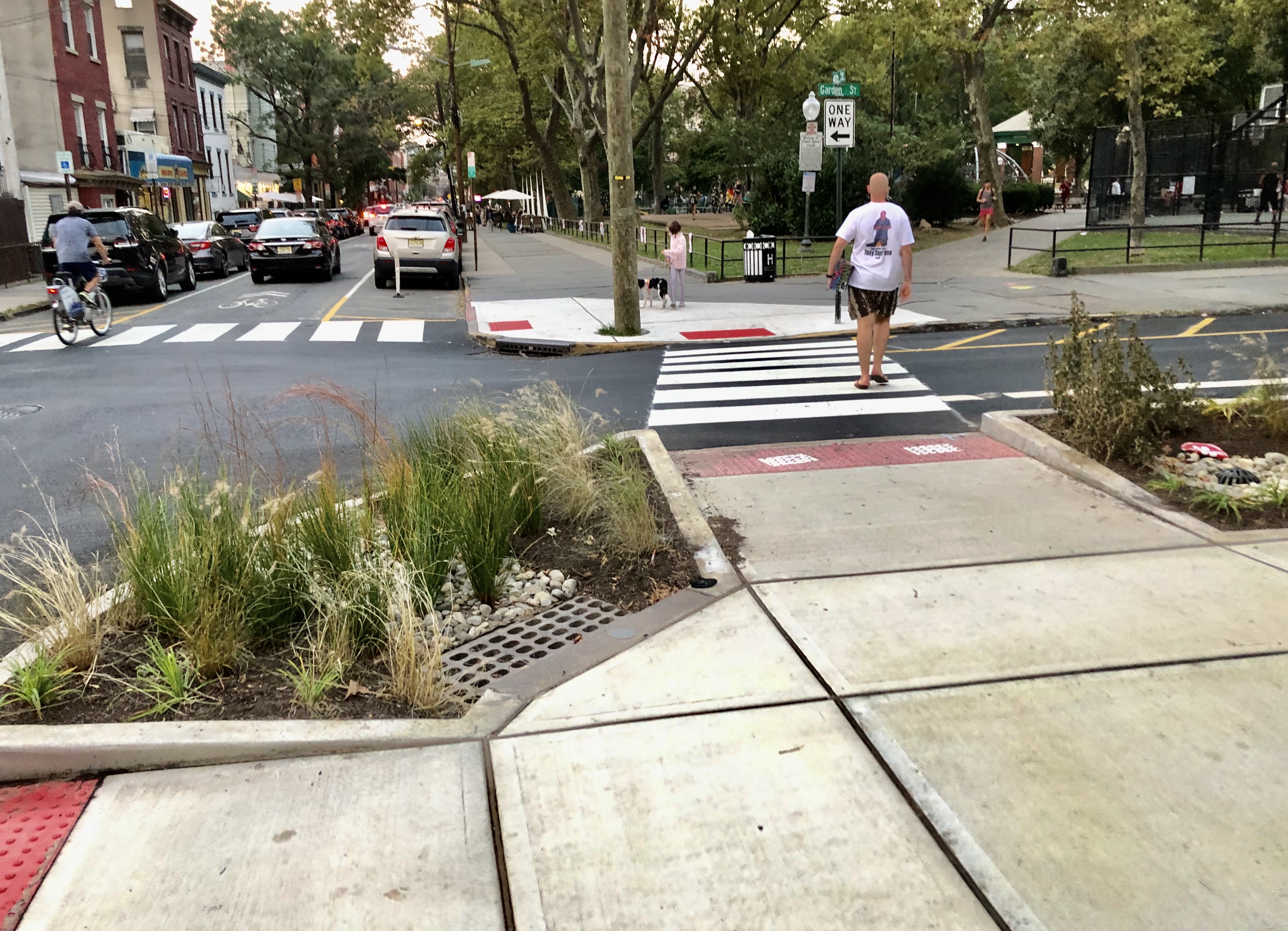
Daylighting clears sightlines; curb extensions also narrow intersections, shorten and protect crossings, and slow turning cars. Traffic calming protects drivers and passengers, too: London’s study of 20 mph zones found substantial reductions in injuries to car occupants. Slowing down over a short distance need add very little driving time. For perspective, half a mile at a steady 20 mph instead of 25 mph takes just 18 seconds longer.
Improvements can start with paint and posts. We can work with school and City staff to choose designs that accommodate buses and keep routes accessible to everyone.
Traffic calming works#
Studies across the world found massive safety benefits of traffic calming measures like speed humps, especially for the children (see Traffic calming works for details).
Our school routes need more speed humps and safer crossings. We can map the gaps together and work with school leadership and City staff to request improvements.
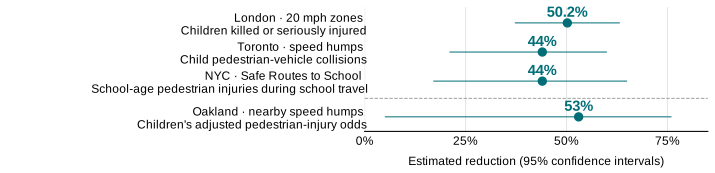
Traffic calming works page explains these findings and more.
Zero is possible#
Hoboken has more residents than Charlottesville, yet it reported nine consecutive years without a traffic death in May 2026, while there have been 13 deaths in Charlottesville during the same period. Its zero-death record began before the City’s 2019 Vision Zero executive order. Hoboken’s May 2026 update; the City’s January 2024 milestone.
Compare the same five years, within each city’s boundaries:
| Charlottesville | Hoboken | |
|---|---|---|
| Residents, 2020 Census | 46,553 | 60,419 |
| Traffic deaths, all ages, 2018–2022 | 13 | 0 |
Population: U.S. Census, Hoboken and Charlottesville. Charlottesville deaths: Move Safely Blue Ridge’s public-meeting boards. Hoboken’s reported zero-death streak includes the full 2018–2022 period.
Much bigger cities have reached zero-death milestones, too:
- Helsinki: 684,000 residents; a full year without a traffic death, reported in July 2025. City and police officials confirmed no fatalities in the preceding 12 months. The city’s traffic engineer credited lower speeds, upgraded walking and cycling infrastructure, safer crossings and intersections, alongside enforcement and good public transport. Yle’s report; city population at the end of 2024.
- Oslo: 709,000 residents; zero pedestrian and cyclist deaths in 2019 and 2023. Its approach includes speed humps, narrower intersections, protected cycling routes and school “Heart Zones” that encourage walking and biking. Nearly 70% of its streets had 30 km/h (19 mph) limits when the case study was prepared. Oslo Transport Authority’s case study, published by TfL; city population on January 1, 2023.
Healthier kids. Ready to learn.#
Walking and biking build physical activity into the school day. Regular activity strengthens and improves fitness, supports attention and memory, and reduces the risk of depression. These are benefits of physical activity that safer school routes can help children enjoy every day. CDC: physical activity benefits for children.

Cleaner air protects growing lungs#
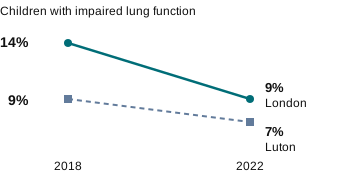
After London’s Ultra Low Emission Zone (ULEZ) began, children’s lung health improved substantially. The share of children with impaired lung function fell from 14% to 9% in London, compared with 9% to 7% in Luton. CHILL study; Queen Mary University of London’s summary.
Driving is expensive for both parents and the school#
For the household side of the costs, see my post Cost of car ownership: the million-dollar decision you’re not thinking about.
Parents pay with fuel and time. The school devotes land and staff time to car drop-off. Walking and biking can reduce those demands when families have safe routes. Cars are the least space efficient and that why we need more space for cars than the school itself.
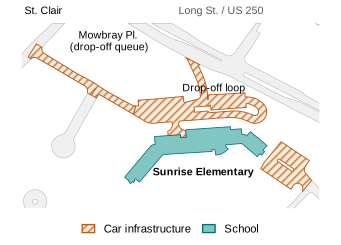
Fewer cars. Faster drop-off. Walking and biking take very little space. More families walking or biking means fewer cars in the queue and faster drop-off for the families who have to drive. Safer routes benefit families however they get to school.
Safer streets make driving safer, too. A U.S. evaluation of 45 road diets in California, Iowa, and Washington found 29% fewer crashes after four-lane roads were converted to three lanes, reducing conflicts between vehicles. In London, traffic-calmed 20 mph zones were associated with 53% fewer drivers and passengers injured or killed, and 62% fewer killed or seriously injured, after accounting for the broader decline in road casualties. Grundy et al. (2009), Table 2. More broadly, a meta-analysis of 33 studies found that neighborhood-wide traffic calming reduced crashes causing injuries by about 15% on average.
Safe travel is an equity issue#
Children’s freedom to get around should not depend on whether their family can afford a car. Bureau of Transportation Statistics data show that transportation takes a larger share of income for lower-income households, especially those with a vehicle. When children cannot travel safely on their own, getting them to school, friends, or activities can require both a car and an adult’s time. Safe walking and biking routes give families more options and children more independence.
How to get involved#
Join the parent network#
Join Charlottesville Safe School Streets, a new, parent-organized email discussion group. Anyone can request to join; conversations are visible to members. Share difficult routes and crossings, connect with other families, and work with principals and school administrators on requests for traffic calming. Track progress together and bring in next year’s families so the effort lasts.
Reach out to YY Ahn at yongyeol@gmail.com if you need help joining or would like to help organize.
Everyone is welcome, however your family gets to school.
Report a problem through MyCville#
MyCville accepts non-emergency service requests through its app or online. The City routes reports to the relevant departments; its biking and walking page lists street and sidewalk repairs, overgrown vegetation, and other obstructions among the uses.
Use it to flag a dangerous street or crossing and ask the City to review it for traffic calming. Describe the problem, suggest improvements such as speed humps or shorter crossings, and ask which department will follow up.
- Open MyCville on your phone, or choose Submit a Request Online on the City’s service-request page. That page also links to the iPhone app.
- Start a request and choose the issue category that best fits the problem. Describe the hazard clearly if none is an exact match.
- Give the precise location: the intersection, side of the street, and nearest address or landmark. Check any map location before submitting.
- Explain what happens and when. For a school route, include arrival or dismissal times and how the problem affects children walking, biking, or using a mobility device. Add a photo if useful.
- Ask for a concrete response, such as clearing an obstructed sidewalk, restoring a faded crossing, or reviewing the location for traffic calming, including speed humps or curb extensions. Submit the request and save its reference number or confirmation.
- Keep a record of the response. If the problem remains after a request closes, follow up with the reference number and explain what is still unresolved.
A suggested description to adapt:
At [intersection/address], [describe the problem]. Children use this route to [school] around [times]. [Explain the specific conflict or obstruction]. Please assess [requested repair or safety improvement] and let us know which department will handle it and what the next step is. Photo attached.
If the app is difficult to use, the City lists 434-970-3333, option 2 as a phone alternative. Reports can be submitted at any time; responses may occur during weekday business hours. MyCville is not an emergency service; call 911 for an emergency. City service-request information
For a near miss, use the separate Close Call Report. It asks for the location, a description including travel direction, approximate date and time, and a reply email; an image can be attached. It helps document incidents that do not appear in crash records. Other examples include Fairfax’s community near-miss reporting and the cycling-focused Close Call Database.
Request traffic calming with school leadership#
A repair request and a street redesign need different follow-through. For speed humps, curb extensions, safer crossings, or a connected school route, we can work with the principal and school administration. We can also ask the City’s Safe Routes to School coordinator to join a walk at arrival or dismissal time and help identify the right process.
Check the City’s school-route maps and infrastructure-improvement list. For missing sidewalks, also see Charlottesville’s sidewalk priorities.
The City still links its 2008 Traffic Calming Handbook, which includes study-request and petition forms. The handbook describes a neighborhood-group request and resident support requirements. Ask staff which requirements apply to the particular school route before collecting signatures; do not assume that a MyCville ticket completes the study-request process.
Contribute through BPAC#
Charlottesville’s Bicycle & Pedestrian Advisory Committee (BPAC) is an open, voluntary group. The City explicitly says no application or appointment is required to participate. It advises staff on walking and biking, including school routes and street improvements. City participation guidance
- Join the BPAC Google Group for discussion and meeting updates. If access is restricted, contact the group owners or bikeped@charlottesville.gov.
- Attend a meeting. The BPAC page lists the first Thursday of the month at 5 p.m., in the City Hall basement conference room at 605 E. Main Street, with a hybrid option. Check that page for the current date, agenda, and online link.
- Bring school-route issues: ask what BPAC and staff can do next.
- Help between meetings by documenting difficult crossings, reviewing proposed designs, or joining a neighborhood walk. Share what families experience along the whole route, including streets beyond the school entrance.
The BPAC page also links agendas, notes, and recordings. The coordinator’s listed contact is bikeped@charlottesville.gov, 434-970-3723. Official BPAC information
Connect with Livable Cville#
Livable Cville is a local community advocating for safer streets and better ways to walk, bike, and get around. Its transportation work includes Safe Routes to School, cycling advocacy, and street safety. It’s another way to connect with neighbors who care about these issues.
Start a bike bus or walking group#
Bike Bus World’s guide covers finding a co-organizer, choosing a route, spreading the word, and starting small. Its route advice emphasizes calmer streets and a consistent schedule. A walking group is another way for families to travel together.
Keep it going#
Reach out at yongyeol@gmail.com if you’d like to help. We can begin with a few families, choose shared priorities, and invite school leadership into the work. A useful request log records the location, concern, request number, responsible office, response, and next follow-up date.
Charlottesville Safe School Streets is our email discussion group for school routes, traffic calming, and organizing across schools. Use the BPAC group for City-wide discussion, and connect with Livable Cville for broader community advocacy. YY’s Bike Shed is my own newsletter about sustainable mobility and urbanism.