Traffic calming
2025-08-29 → 2026-10-10
Traffic calming is a set of street design strategies that slow down cars and make roads safer for everyone. There are many shapes and forms of traffic calming devices, and the details matter—some designs are terrible for everyone, while others work remarkably well.
Strong Towns compresses the principle into one line: “A speed limit is a suggestion. Street design is instruction.” Its caption points to wide lanes, open space, and long sightlines as cues that make higher speeds feel normal.
See Speed limit.
Not Just Bikes has a good visual overview of what works and what doesn’t:
Does it work?#
Yes, and the effect sizes are large: slowing traffic is one of the most reliable ways a city can cut injuries and deaths. See Traffic calming works for the evidence. It is also remarkably cheap next to any other transportation spending, with huge positive externalities like mode shift and climate change mitigation—see Traffic calming is cheap.
Traffic calming documents one city’s corridor-level delivery rate, staffing, contracts, and public tracking.
A recurring implementation dispute is mislabeled as a question of feasibility. Warren Wells points to protected signal phasing rejected because the resulting delay was deemed unacceptable. The treatment was technically possible; officials had made a policy choice to protect travel time over safety. That distinction matters throughout the designs below: practical constraints can often be engineered around, while value judgments should be stated and defended as value judgments.
Types of traffic calming infrastructure#
Bumps, humps, and cushions#
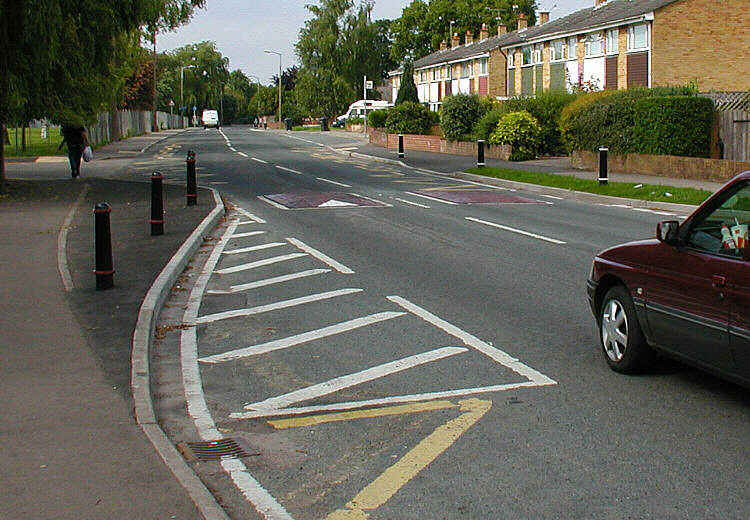
Not all raised devices are created equal—the profile, width, and placement of each type make a big difference for both safety and comfort.
- Q+A: Bumps, Humps, Cushions, Tables—What’s the Best Way to Slow Down Traffic?
- Federal Highway Administration: Effects of Traffic Calming Measures on Non-Personal Passenger Vehicles
- NACTO Urban Street Design Guide: Speed Cushion—a speed hump or table with wheel cutouts that let wide-wheelbase vehicles (fire trucks, buses) pass unaffected while slowing passenger cars, typically used on key emergency response routes
Fire trucks#
A common objection to traffic calming is that it delays or damages fire trucks. The evidence seems clear: the design matters, and devices such as speed cushions and offset speed tables can reduce the delay to small amounts while still slowing ordinary traffic.
Emergency vehicles and street design broadens the question to delays from car congestion and the potential for cycle lanes to provide emergency access.
Damage to fire vehicles is another concern of fire departments. Opinions by some critics in the 1990s and early 2000s were that traffic calming measures caused damage to fire vehicles. ii For example, the stress of traveling over speed humps could lead to increased repairs and shorter vehicle life. However, the early studies found no data to substantiate the claims. iii In addition, isolating the exact cause of wear and tear on a vehicle can be difficult, whether it was caused by the relatively infrequent crossing of speed humps or the crossing of other frequent undulations in a roadway network, such as potholes, manhole covers, drainage dips, etc. … A speed cushion (also known as speed lump or speed pillow) has cushions placed longitudinally in the roadway specifically to match the wheel tracks of fire vehicles (see Figure 5.1) and provide a link to section 3.11 – Speed Cushion. Field tests have shown speed cushions to reduce general vehicle speeds while providing little to no delay to fire vehicles. vi …
Scott Batson’s Portland field tests put numbers on the difference between designs. A conventional 22-foot speed table delayed different fire vehicles by between zero and 9.2 seconds; the largest delay was measured for a rear-tiller truck. Offset speed tables raise alternating halves of the street, allowing an emergency vehicle to use the centerline and take a smoother path. Fire vehicles crossed the offset design at more than 30 mph in driver-choice tests, compared with 14–21 mph over a conventional table. At a 30 mph response speed, Batson estimated that the offset design cut the maximum delay from 4.8 seconds to about 2 seconds, a reduction of more than half. At a live installation in Beaverton, the same basic design reduced the 85th-percentile speed of ordinary traffic from 34 to 30 mph. The design is not suitable everywhere: the version with median islands required a street at least 40 feet wide, while the narrower version needed centerline markings or raised markers to discourage ordinary drivers from copying the emergency path.
The gap between humps/tables is specifically designed to enable a vehicle (usually emergency vehicles and buses) to pass through without being much affected.
Despite the evidence, the claim that speed cushions impede fire trucks resurfaces regularly in local debates. I think this persistence likely stems from a few factors.
First, people tend to conflate different traffic calming devices—older concerns about speed humps delaying emergency vehicles get applied to speed cushions, even though cushions are specifically designed with gaps that match the wider axle of fire trucks. Second, the potential cost of a delayed emergency response is vivid and easy to imagine, while the steady toll of pedestrian injuries and deaths from speeding is diffuse and statistical—making the hypothetical risk of calming feel larger than the proven risk of fast traffic. Finally, when lives are at stake, even a theoretical few-second delay carries emotional weight that data struggles to counteract.
Chicanes#
Chicanes make an otherwise straight street bend. Alternating curb extensions, islands, planters, or parking bays force drivers to steer back and forth, which lowers the speed at which the street feels comfortable. A single bend is usually called a lateral shift; a chicane uses several. The placement matters: if drivers can cut a nearly straight line through it, the chicane will do little. See the FHWA Traffic Calming ePrimer.
Roundabouts#
Neighborhood traffic circles, mini-roundabouts, and full roundabouts all use horizontal deflection to slow vehicles through an intersection, but they are not interchangeable. A neighborhood circle fits inside a local intersection; a mini-roundabout follows roundabout yield rules but may use a traversable center so large vehicles can pass; a full roundabout needs more space and is generally used where larger roads meet. In every case, the approaches must bend enough that drivers cannot shoot straight through. See the FHWA Traffic Calming ePrimer.
Intersection geometry#
NACTO’s safe-intersection guidance treats traffic calming as part of organizing the whole junction. It recommends narrowing or reallocating lanes, restricting or relocating turns, removing unnecessary turn lanes and slip lanes, and shaping corners so ordinary vehicles turn at 5–10 mph. Large vehicles can be accommodated at lower speeds with mountable elements and limited lane encroachment instead of making every turn fast.
Raised crossings and intersections#
A raised crosswalk is a speed table with the crosswalk on top, while a raised intersection lifts the whole junction, often to sidewalk level. Both make drivers climb a ramp before entering pedestrian space; the raised intersection calms both streets at once. Good designs preserve a detectable boundary for blind pedestrians and handle drainage rather than letting water collect at the ramps. See the FHWA Traffic Calming ePrimer.
Curb extensions and chokers#
Curb extensions, also called bulb-outs, extend the sidewalk into the parking lane. At corners they shorten the crossing, make pedestrians easier to see, and tighten the turn so drivers cannot take it as fast. A pair placed midblock becomes a choker or pinchpoint; a narrow one can make opposing cars take turns while leaving a cut-through for bicycles. These can often begin as planters, bollards, and temporary curbs before a city pours concrete. See NACTO’s curb-extension guide.
At an intersection, a curb extension combines Daylighting with a tighter Corner radius: it clears the sightline, shortens the crossing, and makes fast turns physically difficult.
Transportation Alternatives’ Daylighting 101 shows how the cleared curb can also hold bike parking, bus shelters, bioswales, trees, or seating while protecting the sightline.
Median and refuge islands#
A median island narrows the road from the center rather than from the curb. It breaks up the open visual field and bends each travel lane around the island; when placed at a crosswalk, it can also let pedestrians cross one direction of traffic at a time. A raised or landscaped island sends a stronger signal than paint alone, but it still needs enough deflection to change the driver’s path. See the FHWA Traffic Calming ePrimer.
Lane narrowing and road diets#
Wide, numerous lanes invite speed. Lane narrowing reduces that spare room, while a road diet removes or repurposes through lanes across a longer stretch. The reclaimed space can become bike lanes, wider sidewalks, parking, transit space, or pedestrian refuge islands; the common four-to-three-lane conversion replaces two through lanes with one lane in each direction and a center turn lane. See the FHWA Traffic Calming ePrimer.
For the limits of relying on parked cars, see Street parking is traffic calming.
Traffic diverters and modal filters#
Traffic diverters and modal filters reduce speed partly by removing through car traffic. A diagonal diverter forces cars to turn at an intersection; a half or full closure blocks one movement or closes the street to motor vehicles while a gap can preserve a direct route for walking and bicycling. These work best as a network: one isolated filter may simply push cut-through traffic onto the next residential street. See the FHWA Traffic Calming ePrimer.
For school routes and parent organizing, see Safe school streets.