Cars are the least space-efficient
2026-08-29 → 2026-09-13
Cars are extraordinarily space-inefficient. An urban street has a hard physical limit: every added car lane competes with buildings, trees, sidewalks, and other ways of moving. If nearly every trip requires a car, congestion is inevitable (unless the city is destroyed into a multi-lane stroads and parking lots). It is the predictable result of using the least space-efficient mode as the primary mode.
At 1.2 people per car, a bus carrying 60 passengers, including people standing, carries as many people as 50 cars. Put those cars in one lane, and the stopped queue occupies about 1,250 feet (381 meters).
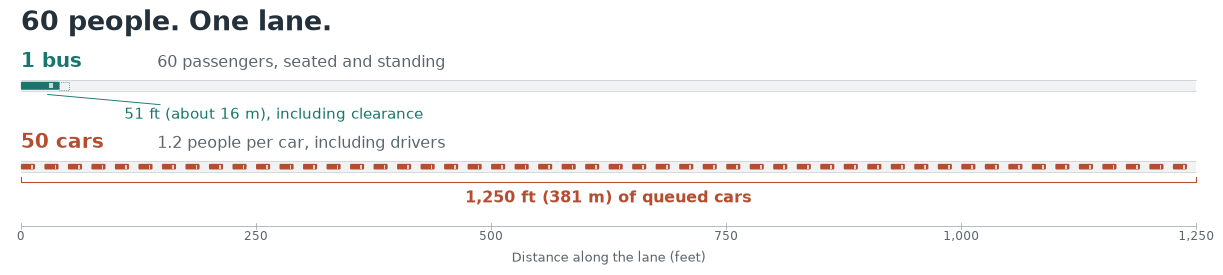
Figure 1: The same 60 travelers in two scenarios, each using one lane. Vehicle lengths and widths share one scale; body widths are illustrative. This compares stopped queue space, not moving traffic capacity.
The comparison assumes 1.2 people per car and 25 feet per stopped vehicle, including clearance. The car drawings assume a 15-foot body and a 10-foot gap; body widths are drawn at 6 feet for cars and 8.5 feet for the bus. These are illustrative dimensions, not measured averages. The example bus is 41 feet long over its bumpers, with the same 10-foot clearance. The 60-passenger load is a scenario, not average bus ridership.
A local example: West Main traffic jam is just 3 buses#
Imagine a stopped queue filling one lane of West Main Street in Charlottesville, from Jefferson Park Avenue (JPA) to Ridge Street. That is about 0.7 miles of cars, based on OpenStreetMap geometry. At 25 feet per car and 1.2 people per car, roughly 150 cars carry 180 people. Everyone in that traffic jam could fit into about three buses.
The geometry does not scale#
NACTO’s peak-capacity estimates show how many people different modes can move through the same width of urban street under normal peak conditions:
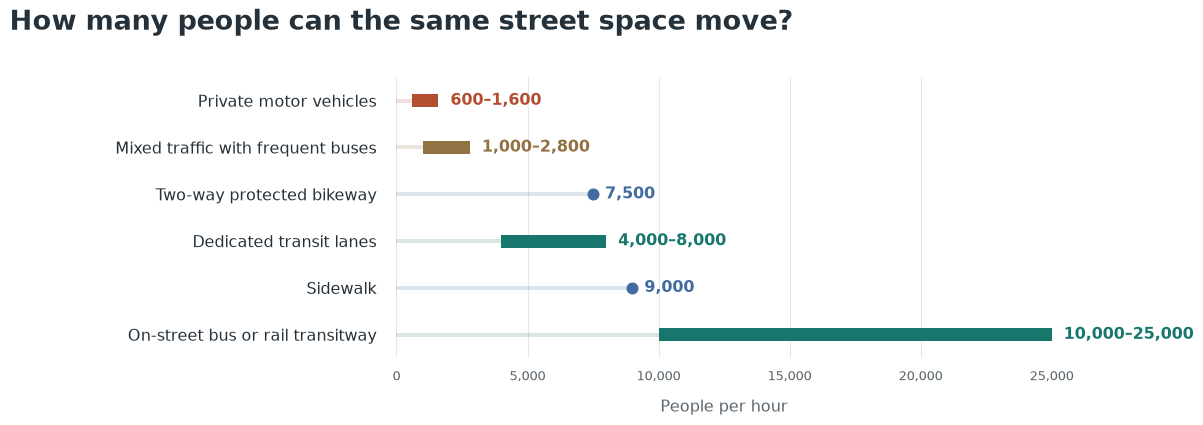
Figure 2: NACTO’s peak-capacity estimates for different uses of the same street width. Solid bars show the reported ranges; dots show single estimates. These are capacities under normal peak conditions, not observed ridership.
Note that this is about capacity; a disconnected bike lane will not attract thousands of riders, and a bus stuck in car traffic will not reach transitway capacity. But the order-of-magnitude difference is the point: private cars require way more street space per person. Whenever we turn a car lane into a connected transit, bike lane, or sidewalk that can be used well, we double, triple, quadruple the capacity of the street without widening it. In a large Swiss visual choice experiment, Wicki et al. (2026) find that greenery consistently increases public acceptance of such people-first street redesigns.
Making alternatives to driving viable develops the practical requirements for choosing another way to travel.
More lanes create more driving#
Road expansion can reduce delay temporarily, but the easier trip changes people’s behavior. They change routes, departure times, destinations, modes, and how often they travel. Moreover, wide, multi-lane roads make them drastically more hostile to pedestrians and cyclists, further suppressing alternative and way more space efficient modes. Over time, households and businesses also change locations. This is Induced demand.
Gilles Duranton and Matthew Turner found that vehicle-kilometers traveled rose roughly in proportion to interstate lane-kilometers across US cities (2011). The added traffic came from more driving by current residents, more commercial traffic, and migration. The authors also found no evidence that merely providing public transit reduced total driving. Alternatives must be actually useful, and cities must stop continually making driving cheaper and easier at the same time.
Fewer car trips, not worse access#
The scalable goal is not to prevent people from reaching jobs, schools, shops, or friends. It is to provide the same access with fewer car trips. Walking, biking, and transit must be safe, connected, reliable, and competitive enough that people can choose them without accepting a major penalty.
Congestion pricing, parking reform, compact land use, telework, and better non-driving infrastructure use different mechanisms, but they share the same basic logic: fewer cars compete for limited road space at the busiest times. If no practical alternative exists, reducing car capacity merely makes travel harder. If good alternatives exist, some trips shift modes, times, destinations, or disappear from the road network altogether.
Not everyone needs to stop driving. Every person who can make a trip without a car frees a disproportionate amount of space for people who still need to drive. Good walking, biking, and transit can therefore make driving better too.
Traffic can disappear#
Road-space reallocation does not mean that every displaced car moves to the next street. A review of more than seventy cases across eleven countries found that traffic problems were usually less severe than predicted. The median share of traffic formerly using the treated road or area that could not be found in the surrounding network was 10.6%; the mean was 21.9%. People adapted in many ways rather than all sitting in the same queue somewhere else. This is Traffic evaporation.
Traffic demand is not a fixed quantity waiting to be accommodated. As Traffic projection explains, street design helps create the traffic that models later treat as inevitable.
Bottom line#
You cannot solve urban traffic by fitting more cars into a city. The durable solution is to make fewer trips require one by making other modes genuinely viable.
For school routes and parent organizing, see Safe school streets.